Showing posts with label Reading. Show all posts

Thursday, June 2, 2011

Early Summer Reading List

Taz Caracal is in favor of a lazy summer afternoon
Thanks to my daily bus ride commute to and from werk, I have plenty of time to either read, edit or take naps.  Lately, the two choices that have nothing to do with writing have been winning.  This as, in part, been due to having found several very good books to read.  The napping part, well, let's just say that naps, like youth, are wasted on the young.

(You can quote me on that, too.)

The weather was actually being relatively mild until last week, so regardless of what the calendar or the tilt of the earth's axis might have to say about it, I'm considering last week to be the first week of my summer reading.  As such, I've read two books I heartily recommend:

The first book is Hannah Moskowitz's INVINCIBLE SUMMER.  Told over the course of four summers by Chase, a teenager in a broken family that's maintaining, barely, during their summer vacations at their Bethany Beach summer house.  It's a story of family, friendship, differences and the tragedies live brings through everyday living.  What impressed me so much about INVINCIBLE SUMMER was how long the book has stayed with me.  The emotional chord stuck was like the end of is still vibrating in a way that makes me respect Moskowitz's skill as a writer almost enough to forgive her for being so good while being so danged young.

The next book was something quite different: KAT, INCORRIGIBLE by Stephanie Burgis.  This is a book set during the Jane Austin era and mixes the social mores and sensibilities of that time with a family whose daughters have a touch of witchcraft in their veins.  This power is most strongly given to the youngest daughter, the headstrong and willful Kat, who through the course of the story makes a convoluted and oddly magical story even more complex and problematic.  What I liked most about KAT, INCORRIGIBLE was Burgis' way of making Kat's headstrong solutions to problems rarely work out for the best and how Burgis kept making things worse and worse and worse for all of her characters throughout the book.  It was a fun read and I'm looking forward to the next book in the series.

Last week Christine Brodien-Jones wrote an entry over at the new middle-grade writers blog, Smack Dab in the Middle, about ten of her favorite fantasy books.  Most of the ones on the list that I haven't read yet have just arrived in the library for me, so I have my next few weeks' worth of reading already mapped out.

What about you?  What have you read that you've liked lately?  What's on your summer reading list?


-- Tom

Tuesday, November 2, 2010

What I've Been Reading: October Edition


The Mortal Engines Quartet (aka "The Hungry Cities Chronicles") by Philip Reeve

The Mortal Engines Quartet is made up of four books: Mortal EnginesPredator's Gold, Infernal Engines, and A Darkling Plain.

Mortal Engines is an imaginative look at the future, where cities are mobile and, with resources limited, larger cities attack and devour smaller, weaker cities to survive.  (i.e. Municipal Darwinism)  It's a fast-paced story of a very junior level historian (male) and the would-be assassin (female) who tries to kill the junior-level historian's hero.  After being dumped off of the moving city of London, the pair have to survive by their wits, while the would-be assassin is being tracked by a resurrected killing machine.

With it's mix of wild imaginings, interesting and complex characters and the continual action that builds to one heckuva climax, Mortal Engines was a great book.  Despite the surprisingly high body count (or maybe because of it) I had very high expectations for the sequel, Predator's Gold.

Instead, Predator's Gold slowed the pace way down.  Making matters worse, an awful lot of the book seemed to want to concern itself with relationships and, particularly, jealousy.  This tainted so much of the story for me that I wasn't sure if I wanted to continue the series.

With Infernal Engines, Reeve made a very strange decision.  The two teenaged main characters of his first two books are now parents with a teenaged daughter who can't stand her parents.  She strikes off, impulsively, for an adventure of her own that then puts her parents and everyone in her home city in danger.  I ended up not liking her character much (how can you like a character who is, essentially, a spoiled brat and who doesn't understand nor appreciates the two people we've already spent two books getting to know and rooting for?) and being so annoyed with her and the almost soap opera-like direction of the book that by I finished Infernal Engines I wasn't sure if I really wanted to read A Darkling Plain.

In the end, I decided to read the Wikipedia entry on A Darkling Plain and decide if it sounded worth the time to read.  It didn't, so I moved on.
_____________ . . . _____________


Larklight: A Rousing Tale of Dauntless Pluck in the Farthest Reaches of Space

So, from one Philip Reeve series to another.  Where Mortal Engines was a gritty, hardscrabble series, Larklight was, well "a Rousing Tale of Dauntless Pluck in the Farthest Reaches of Space"!  I mean, honestly, how can you go wrong with a subtitle like that?  It's  Steampunk meets Alternate Physics meets Space Pirates meets Alien Invaders and was a whole lot of fun to read.  It was one of those books I wish I had written.


The book is written in first-person by young boy who is full of Victorian nationalism (Huzzah!) and adventure who also steals sections of his very prim and proper older sister's diary to fill in parts of the story.  It's fun, funny and filled with David Wyatt's wonderful illustrations.  

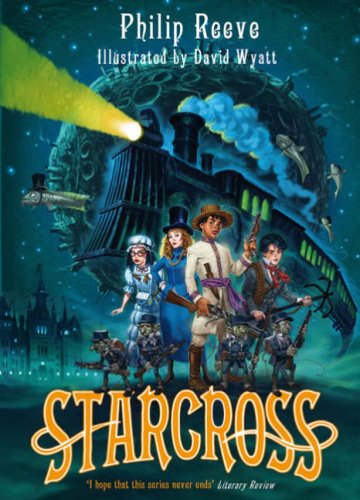
All of which gave me high expectations for the sequel, Starcross: A Stirring Adventure of Spies, Time Travel and Curious Hats.

After the bracing storytelling behind Larklight, I was somewhat disappointed by the slower aspects of the story in Starcross.  Add to that, it seemed that far too much attention was spent on relationships and, particularly, jealousy.  Hmmmm.

For me, the slower pace of Starcross gave me more time to think about the plot--a species of time-traveling creatures come back to Victorian times and are able to control people by taking the shape of top hats.  Yes, there was plenty of activity in the story and yes our heroes were called upon to Save the Universe again, but this book didn't make such a favorable impression on me.

That isn't to say the overall writing and illustrations weren't up to snuff.  There were aspects of the book that were quite funny.  (The prim and proper Victorian era sister spends the majority of the story dressed in an inflatable bathing suit, for instance)  It's just that Starcross wasn't exactly the book I was hoping it would be.


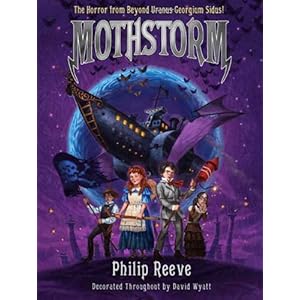
Mothstorm: The Horror from Beyond Uranus Georgium Sidus!, however, was exactly the book I was hoping it would be.  Space pirates (being space pirates again), an alien invasion, epic space battles, a long-standing mystery solved, courageous acts of daring-do and even more fun.

Saving the universe is rarely this much fun.  But it should be.


_____________ . . . _____________


After liking the Leviathan so much last month I was a bit worried about the sequel, Behemoth.  Could it live up to the first book?  Could Westerfeld keep the pacing up?  Would the story move forward in a way that felt natural and logical?

I needn't have worried.  Behemoth was a great book.  Even more alternate history and bizarre steampunkery goodness made this a fun read and eager for the third book in the series.

One of the things I liked about Behemoth was how Westerfeld upped the stakes for his main characters without being predictable.  The power struggle Alek and Deryn get involved in is not of their making, but plays into their separate goals nicely.  The unexpected twist at the end of the story, one that throws so much anticipated action for the third book, was very well played and caught me completely off guard.


_____________ . . . _____________


SPHDZ (or Spaceheadz) by Jon Scieszka and

I'm a big Jon Scieszka fan.  I've read the first four of his Time Warp Trio books to over 600 students and have wanted to write something that comes even barely close to the brilliance of those books for years.  If Scieszka writes it, I'll read it.

Which is part of what makes not liking Spaceheadz so difficult.

Spaceheadz felt underdeveloped, as if it was the germ of an idea that was tossed off quickly.  The characters are either wooden or predictable, the situations not all that funny and the story just left me wanting more.  Not more in terms of a sequel, but something more to happen.  The entirety of this book could have been edited down to half its length, allowing for a real conflict and resolution to be developed.

_____________ . . . _____________


A neat concept: Olive and her two math nerd parents move into an old Victorian house filled with paintings that are stuck to the walls.  After finding an old pair of glasses Olive is able to see movement within the paintings and even climb into them.


Between a missing boy she finds in one of the paintings, a trio of cats who are guarding... something, a mysterious and hidden attic, a necklace retrieved from the lake in one of the photos and the dark figure everyone seems afraid of, the book has a lot going for it.  As well, Olive is a gutsy girl, not willing to let herself be stopped by things that scare her.


While I liked the imagination behind The Shadows, there still seemed to be something missing here for me.  I've thought about it and I'm just not sure what it is.  (Aside from an ending that seemed a bit of a let-down)  I enjoyed this one, but I'm not sure I'll continue following the series.

_____________ . . . _____________


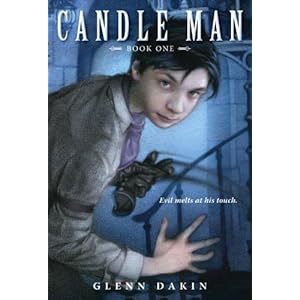
Theo has been kept a helpless, sheltered boy from his earliest days, seeing only three people for most of his life: his guardian, the guardian's assistant and a maid.  The reason for the isolation turns out to be a secret power Theo has inherited from his ancestors: when he touches a criminal, the criminal melts.

Rescued by a small group bent on restoring Theo to his rightful place as a crime fighter, Theo finds himself with friends, responsibilities and as the only person who can stop his former guardian from unleashing a host of evil creatures on the world.

Despite uneven pacing and lingering questions I had about how Theo would really approach a world he had been completely sheltered from for his entire life, this was still a fun and interesting read.

_____________ . . . _____________

So, what are you reading?  What have you liked lately?  What have you given up on trying to finish?  And what books would you recommend me adding to my TBR stack?


-- Tom

Friday, September 24, 2010

What I've Been Reading: Mid-August '10 Edition

So far I've been doing a lot of writing about writing but not so much about reading.  It seemed to me to be time I wrote a bit about what I've been reading, why I've been reading them and what I thought about them. 

Livvie Owens Lived Here
by Sarah Dooley 

Livvie Owens Lived Here by Sarah Dooley 

I won a copy of Livvie Owens Lived Here through an online contest.   I probably wouldn't have picked it up otherwise, which only goes to show that I need to keep myself far more open to books outside what I would consider my "regular" genres.

Author Sarah Dooley has taken on a substantial challenge: to write a YA novel from the perspective of a teenaged girl with autism.  Dooley, who works with autistic children during her 40-hour work-a-day week, does a fairly good job of balancing what seems believable language and thoughts for Livvie and her desire, as a writer, to be eloquent and almost poetical in her descriptions and similes.  There were times I thought this worked well and other times a sentence pulled me out of the story as seeming less believable.

The blurb on Goodreads for Livvie Owen reads:
"Olivia "Livvie" Owen feels things differently than her parents and two sisters. Livvie is autistic. Her family has had to move repeatedly because of her outbursts. When they again face eviction, Livvie is convinced she has a way to get back to a house where they were all happy, once.

The problem is, Livvie burned down that house.
"
And while this is true, the description really does an injustice to the book.  The story is really about the way a family that is both financially strapped and on edge, come to terms with changes in their lives.

I read Livvie Owens over the course of two days and, by the end, was disappointed their story didn't go on longer.
_____________ . . . _____________
Undress Me in the Temple of Heaven
by Susan Jane Gilman

Undress Me in the Temple of Heaven by Susan Jane Gilman 

I don't remember where I found a copy of Susan Jane Gilman's Hypocrite in a White Pouffy Dress, but two things grabbed me about it right away: the cover (seriously, click through and take a look.  I'll wait.... It's a seriously great cover, isn't it?   How can you not want to read a book with a cover like that?) and the cover blurb from Frank McCourt that reads:

"Thank you, O Lord, for sending us Susan Gilman's tales..."

Where Hypocrite... is a collection of stories about Gilman's upbringing in New York City, of her parents' attempts at having their children taught 'enlightenment' and of growing up (a bit), Undress Me in the Temple of Heaven is the story of a daring, foolhardy trip Gilman and a college friend take in the mid 1980's, shortly after college graduation, to China.

And just because this image makes
me so very a happy: the fabulous
Frank McCourt and his former student,
the equally fabulous Susan Jane Gilman
At the time, China had just begun opening up to Westerners and Gilman and her traveling companion (known pseudonymously as Claire Van Houten) are the first whites that many of the Chinese have ever seen.  They are treated with equal parts awe, suspicion, mistrust and as potential friends by the various people they meet.

I love good, quirky travel books and Gilman's writing about t his trip would have been enough for me to be completely happy with it.  However, it turns out that being completely out of her element, at various stages panicked, sick enough to need hospitalization, unfamiliar with the language, food or customs was the easy part of Gilman's trip.

The real problem was that her traveling companion's odd behavior wasn't just becoming odder and odder.  It was that her traveling companion was suffering from full-blown, undiagnosed paranoid schizophrenia.  In a foreign country.  That was already highly suspicious of Western culture.  Where traveling from place to place usually took a day or two of waiting to fill out the forms to buy tickets and then another day or two to pick up the tickets.  Where as hard as it was getting into China, getting out is even harder.

Undress Me... has now supplanted Hypocrite... as my favorite Susan Jane Gilman book.

_____________ . . . _____________

The Glass Maker's Daughter
by Vance Briceland


The Glass Maker's Daughter by Vance Briceland


Full Disclosure: I've known Vance online through his LiveJournal for... well, I forget how many years.  Vance has prodded and nagged me along the lines of "Why, exactly, aren't you writing" for several years and has helped me with several mentor-y tips along the way.  I've read several of his other books (published under another name) and was thanked in the introduction to one of them for some last-minute, final-read-before-being-submitted work I did for him.  When I get my first book published, he's one of the people who will be publicly thanked.

That having been said, I still liked The Glass Maker's Daughter.

The story starts by setting up the time-honored traditions of Cassaforte, the nightly rituals that supposedly keep the kingdom safe and the ceremony that gives each child his occupation in life.  The heroine of the story,  Risa, expects to be chosen by the gods to follow in the family's glassmaking (plus enchantments) business.  Instead, she the gods decree they have no placement for her.

Twisting away from what appears to be a Lowry's-The-Chosen beginning, Risa finds herself in the midst of political intrigue that threatens to destroy her homeland.  She finds her way, in part, with the help of two of the Prince's guards and, in part, through her own stubbornness -- a trait that lands her in increasingly more trouble.

Risa is wonderfully flawed, eager to prove herself while not yet truly understanding herself or her homeland.  It's a fun read, with enough action and danger to keep the pages turning.

(I'm also looking forward to reading the two sequels , The Buccaneer's Apprentice and The Nascenza Conspiracy)


_____________ . . . _____________

The Affinity Bridge
by George Mann
The Affinity Bridge by George Mann 

Classic Steampunk in all the right ways.

A passenger airship crashes in the middle of Victorian London killing all aboard and the brass and gearwork automaton pilot cannot be found.  Queen Victoria (kept alive by various life support systems) asks Sir Maurice Newbury to investigate.  Along the way, Newbury and his assistant, Miss Veronica Hobbes, are attacked by automatons and, yes, zombies.

Mann gets the Victorian societal sensibilities just right.  Despite the mysteries to be solved and the unfortunate undead to be avoided, there still remains a hesitancy towards displaying emotions.  I had the sense that while Mann took his characters and his story seriously, he was also making sure that he didn't take everything so seriously he didn't have fun with this story.

At the heart of this book is a mystery that not only moved the action along, but kept me guessing as well.

This was a dashedly fun book to read.  (I'm already on the lookout for the sequel, The Osiris Ritual)


_____________ . . . _____________


The Difference Engine
by William Gibson
and Bruce Sterling
The Difference Engine by William Gibson and Bruce Sterling  

A Steampunk classic... for some reason.

Okay, so the Wikipedia article for this book proclaims, "It is a prime example of the steampunk sub-genre." And, yes, I grant you that it is "science fiction re-imagined from a Victorian perspective." And, yes, there are technological advances unknown to the real Victorians.  And, yes...

The problem is, there just isn't much of a story here.

I knew I was in trouble when I got to page 66 and wondered why I was wasting my time.  The book had completely changed directions after the first section, leaving me with characters I wasn't interested in who were in situations I didn't care much about that had little in the way of rising tension and conflicts.

By page 250 I decided since I'm writing Steampunk I should be able to say I've read what many consider to be a classic of the genre.  I would finish it just to say I had finished it.  Bragging rights, I thought.  It's a challenge.

Then by page 265 I decided life is too short (and my bedside To Be Read stack of books too tall) to spend time slogging through a story that just does not connect with me.  At all.

I suspect some of my annoyance stemmed from having just read several very good books.  Still, with so many good ones out there, why spend time with ones that don't work for you?

_____________ . . . _____________

So, what are you reading?  What have you liked lately?  What have you given up on trying to finish?  And what books would you recommend me adding to my TBR stack?


-- Tom